Is Sculptra in the lips a good idea?

January 6th, 2010

Facial Fillers has the potential for nodules and this can be more of an issue in the soft tissue of the lips. The makers of Sculptra, due to prior treatments to the lips, have concluded that Sculptra in the lips is not advised.  Other options for lip augmentation include restylane, juvederm which are temporary fillers for the lips. Some permanent options include fat injections, lip lifts, vy advancements, corner of the lip lifts, tissue grafts for the lips, etc.

Hope that helps!

Thanks for reading, Dr Young

Dr Young specializes in Facial Cosmetic and Reconstructive Surgery and is located in Bellevue near Seattle, Washington

What are the long term side effects of Sculptra? Is it a smart choice? Who are the best candidates?

December 30th, 2009

Facial Fillers is actually the powder form of a suture, Vicryl, that has been used in surgery for many years without significant problems. The body absorbs the powder and eventually turns it into carbon dioxide and water. The benefit of Sculptra is that during this inflammation to degrade the Sculptra collagen formation is being carried out by the body in a scar like reaction. It is this collagen that creates the new volume.  With this inflammation there is the risk of infection.  However the benefit of having the inflammation to create the collagen in a scar form is paradoxically what can lead to the infection.  If you didn’t have this inflammation you wouldn’t have as much collagen formation.

In my opinion, Sculptra is most beneficial for the person who does not have a lot of fat in the rest of the body to undergo fat injections and would like some more volume in the face.  It is also useful in the person who has only a little fat to offer for fat injections.  In this particular situation I would use sculptra in the areas that can tolerate it more such as the cheeks, mouth area, temples, forehead and jawline areas and reserve fat injections for the areas closer to the lips and around the eyes.  It is also good to use Sculptra for people who don’t want the invasiveness of fat injections where you have the need to harvest the fat from somewhere else. Sculptra, in general, is less of a process than fat injections.  But with the negatives that come with Sculptra, there is a lot of positives for people in these situations above.

From a long term standpoint, once the Sculptra is dissolved there should not be long terms issues. If a person somehow does not degrade the Sculptra effectively there could be infections but there are ways to treat these issues without a lot of problems.  Silicone injections and Artecoll injections present more long term issues in my opinion.

Hope that helps!

Thanks for reading, Dr Young

Dr Young specializes in Facial Cosmetic and Reconstructive Surgery and is located in Bellevue near Seattle, Washington

Can you Fat Graft / Transfer Around a Facial Implant? Can you Fat Graft / Transfer / Inject into the area if you remove the Implant?

December 30th, 2009

You can graft around an implant but it depends on the blood supply around the implant.  Typically, around the implant a layer of scar tissue usually forms. Scar tissue is notoriously known for its low blood supply.  Bringing fat next to the implant has the potential to live if done right.  Over time with the survival of fat around the implant, additional fat grafting (or Fat transfer / Fat Injections / Fat Transplants / Fat augmentation / Fat enhancements) can be done there to further increase the volume around the implant. If you remove the implant, the success of fat grafting can be attained but within the scar tissue, the fat has a more difficult time to survive.  This may mean that you will need to do more touch ups to the area.  Fat grafting can lead to long term results.  It is all about the technique.  In my practice, fat does survive and sometimes near 90% of the fat can survive.  This is true, so much so, that I need to be careful not to put too much fat in to certain areas.  It is easier to put more fat into the area than to take it out. Here are some results of fat grafting:

Hope that helps!

Thanks for reading, Dr Young

Dr Young specializes in Facial Cosmetic and Reconstructive Surgery and is located in Bellevue near Seattle, Washington

Before Fat Grafting / Transfer / Injections to the Forehead, Temple, Upper / Lower Eyes, Cheeks, Nasolabial Folds, Marionette Lines, and Mouth Area

Before Fat Grafting / Transfer / Injections to the Forehead, Temple, Upper / Lower Eyes, Cheeks, Nasolabial Folds, Marionette Lines, and Mouth Area

After Fat Grafting / Transfer / Injections to the Forehead, Temple, Upper / Lower Eyes, Cheeks, Nasolabial Folds, Marionette Lines, and Mouth Area
  • After Fat Grafting / Transfer / Injections to the Forehead, Temple, Upper / Lower Eyes, Cheeks, Nasolabial Folds, Marionette Lines, and Mouth Area
  • Lip Advancements for Permanent Lip Augmentation

    December 20th, 2009

    Although during these present times, people are opting for fillers and more temporary correction of thin lips and for lip augmentation, there are permanent options for lip augmentation.  Most of the time these permanent options have a longer recovery time.  But, in the long run you will save money and not have to undergo repeat injections that could happen twice a year depending on the filler that you choose.  Lip advancements are one way to increase the pout of your lips while adding some volume.  Most of the time these lip advancements are done in a V-Y fashion.  What that means is that the inside of the mouth begins in a V shape and drawing.  With the wide part of the V representing how wide you want the lip augmentation to be.  The pointy V part usually starts way inside your mouth inferior to your teeth in the gutter part of your mouth.  When the V is incised it is pushed forward to increase the pout of the lip.  When the V is advanced, the part that is inferior to the pointy part of the V can be

    closed in a straight line creating the vertical portion of the letter Y.  Here are some pictures explaining it and also some before and afters from this procedure.  Importantly, I incorporated my theory on facial beauty to get these optimal results.  This result is 2 weeks after the procedure and will get better and better. One thing to notice is that the lower lip is much bigger than the upper lip.  This maintains the correct balance of the lips.  In fact, the lower lip should be twice the size as the upper lip to maintain the optimal aesthetics for this area. The center puckering of the lower lip should also emulate the eye and the pucker should create a highlight approximately 3 iris widths in length, essentially the size of the width of the eye.  The height of the lower lip should be one iris width for optimal aesthetics. Below the dash lines represent the right orientation but they are located inside the mouth. This patient had 3 of these V’s on the bottom and top lips for a total of 6 V-Y advancements.

    Hope that helps!

    Dr Young specializes in Facial Cosmetic and Reconstructive Surgery and is located in Bellevue near Seattle, Washington

    Picture1

    Picture3AC 03 beforeAC 04 after

    I have a Polly Beak and how do I correct it? Also I still have a crooked nose after 2 rhinoplasties.

    December 14th, 2009

    This is a question that I answered for a patient who had the issues above and this is my answer:

    Your polly beak is very small and should be easily corrected. The polly beak looks higher than one that would be due to scarring. I would venture to say that the polly beak that you have is probably due to cartilage being left in and this can be easily reduced.

    The crooked bone and septum can also be fixed.  I usually only need one procedure to correct a crooked nose.  A crooked nose requires the most extensive knowledge regarding Rhinoplasty(nose job, rinoplasty, nose plastic surgery, nose cosmetic surgery, nose shaping, nose reshaping) so its not surprising that you might still have that after having undergone two rhinoplasties.  Also one thing to realize is that rhinoplasties are the hardest surgery that a facial plastic surgeon can do.  There are many variables that can contribute to a less than perfect result.  Many times a crooked nose entails some complicated maneuvers along the key areas of cartilage that hold your nose up which many surgeons are not comfortable venturing into.  If you are not careful your whole nose could collapse if not done well.  Many times the cartilage is what is holding your nose in a crooked nature and it requires releasing cuts into the cartilage itself to release the crooked forces that hold your nose in that state.  Then the cartilage needs to be reconstituted and strengthened with other cartilage to solidify the new form.

    Hope that helps!

    Thanks for reading, Dr Young

    Dr Young specializes in Facial Cosmetic and Reconstructive Surgery and is located in Bellevue near Seattle, Washington

    What can be done for protruding lips?

    December 14th, 2009

    A lip reduction procedure will help you tremendously. A lip reduction procedure entails incisions inside your mouth and lips and resecting a portion of the lips to reduce the overall size.  This procedure can be done in an outpatient setting and should take about 1 hour or so.  It is relatively a low risk procedure and it can be done under just local anesthesia or with iv sedation.  General anesthesia is not necessary and actually makes is harder in some ways.

    Hope that helps!

    Thanks for reading, Dr Young

    Dr Young specializes in Facial Cosmetic and Reconstructive Surgery and is located in Bellevue near Seattle, Washington
    Revising the earlobe due to a delay from a keloid in the area after an otoplasty procedure.

    December 8th, 2009

    Setting back the earlobe is not a difficult thing to do during otoplasty (ear shaping, ear pinning, ear reshaping, ear plastic surgery, ear cosmetic surgery, earplasty). You can cut the cartilage that holds the earlobe out (called cauda helicis). You can also adjust the skin to pull back the earlobes the right amount.  This can be done really anytime unless there are some things that were done near the area that might require healing before the earlobe revision.  The length of time to wait can be from 3 months more or less.

    The biggest confounding issue is the Keloid.  The keloids can come back over and over again.  Steroids and excisions are the most common way to remove keloids. Sometimes, local flaps and recruitment of extra tissue and skin can be needed to remove keloids.  You should be prepared to have more than one revision to take care of the keloid.

    Hope that helps!

    Thanks for reading, Dr Young

    Dr Young specializes in Facial Cosmetic and Reconstructive Surgery and is located in Bellevue near Seattle, Washington
    Trauma to the nasal tip causing a broken nasal tip and whether changes to it can be made to look better.

    December 8th, 2009

    This is a question someone had asked regarding whether a broken nasal tip could be fixed. He had mentioned that the tip is now more droopy, bulbous and has irregularities on the surface above and on the nasal tip.

    Rhinoplasty can fix your broken nasal tip. When you say broken, it might be good to mention that there are actually no bones in the nasal tip.  The nasal tip is made up of cartilages and your trauma to the nose could have caused the cartilages to be damaged. The drooping may have been caused by some of the cartilage losing its connections from elements that are higher up on the nose.  The bulbous change could be from scar tissue. All of these changes though require quite a lot of force, so you must have hit your nose pretty hard.  These changes can all be improved for you through rhinoplasty (nose job, rinoplasty, nose plastic surgery, nose cosmetic surgery, nose shaping, nose reshaping) and it will essentially require tip work and very likely no treatment to your nasal bones.  One question is whether you have closely looked at the pictures of yourself long before.  Sometimes people notice things more after an event and attribute it to the event when it was really has been happening for a long time.  This is just a thought though and all this could be from the trauma.

    Hope that helps!

    Thanks for reading, Dr Young

    Dr Young specializes in Facial Cosmetic and Reconstructive Surgery and is located in Bellevue near Seattle, Washington

    Difference between co2 laser resurfacing with Lumenis and their active fx / deep fx / total fx / max fx technical advances explained

    December 7th, 2009

    active_deep_totalfx

    skin anatomy

    skin anatomy

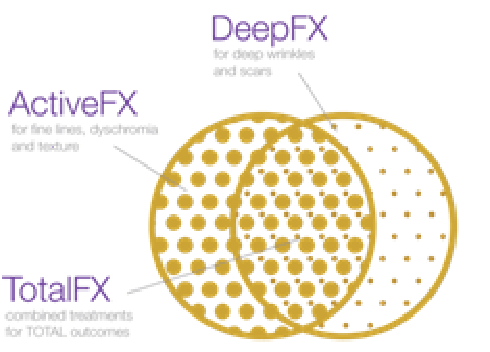
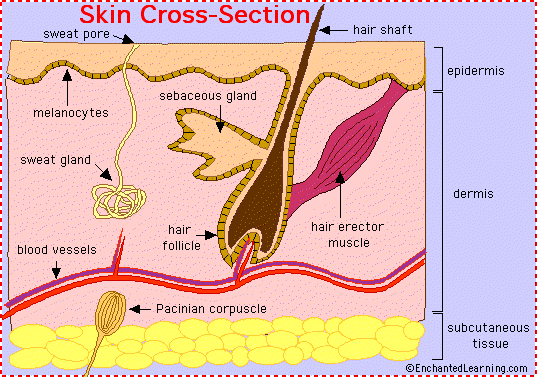
    A knowledge of skin anatomy can help with understanding resurfacing (laser peel, laser skin rejuvenation) of all types including laser, chemical, dermabrasion.  Taking a look at the cross sectional area of the skin, you can see that the skin is broken up into basically two areas, the epidermis and dermis. All resurfacing progressively take away layers of skin and by doing so remove skin lesions, unwanted pigmentation, wrinkles etc.  What happens is that the deeper skin cells located in the depth of the hair follicle eventually resurface and repopulate the skin.  during this process a layer of scar tissue and collagen is formed under the new basement membrane.  This new layer of collagen is thought to be responsible for some of the benefits of resurfacing including tightening of the skin and maintaining the decrease state of wrinkles.  The basement membrane is the connective tissue floor that the stem cells rest on where they reside and repopulate the more superficial layer of skin cells.  Active Fx essentially takes away more superficial layers confined to just above or just below the basement membrane depending on how many passes are done, what power and what density is chosen.  The basic principle of active fx is the use of a fraction of the spot size.  When you look at the picture above you can see that active fx has some wide dots, wider that the deep fx.  But the key are the areas in between the dots that represent untreated skin.  This untreated skin allows a faster recovery and less down time.  The goal is to get some of the effects of resurfacing without the downtime.  To help with the results of active fx, deep fx was added to create more tissue tightening to a deeper level.  Notice in the picture that with deep fx the dots are thinner.  Deep fx is thinner but it reaches to a deeper level heating up deeper layers and leading to more tissue tightening to a thicker amount of skin.  When deep fx is combined with active fx you can get better results than when each are used alone and this is done with less downtime than traditional resurfacing.  Total fx is when active fx is combined with deep fx.  Traditional resurfacing can be explained by active fx and that approach.  The difference is that the dots are much closer together and depending on whether you increase the density of the dots the dots may overlap to a varying degree.  When the dots start to overlap at a density of 4-5 you start to get into more traditional type of resurfacing where all parts of the skin are taken away or ablated per spot.  This approach does not leave healthy skin in between the treated dots, so the downtime is like older approaches. This use of active fx with dots touching or overlapping is more appropriately called max fx, or traditional co2 resurfacing. One thing to remember is that the more aggressive you are the more results but also the more risks are involved.  Total fx tries to get more results than you would normally get with a certain amount of risk. Here is a live demonstration of my use of a co2 laser and laser resurfacing.

    Thanks for reading, Dr Young

    Dr Young specializes in Facial Cosmetic and Reconstructive Surgery and is located in Bellevue near Seattle, Washington

    How much reduction can a bulbous tip actually receive and will it look much differently?

    December 7th, 2009

    Reducing the Bulbous tip can be done but the results often depend on what the tip is made of during Rhinoplasty (nose job, rinoplasty, nose plastic surgery, nose cosmetic surgery, nose shaping, nose reshaping). If the bulbous tip is made up of thick skin this presents a dilemna.  A surgeon can defat the tip but this can increase irregularities to the skin and also can cause skin to possibly be devascularized and worst case scenario die partially.  If the tip is made up of cartilages mostly creating the bulbous tip, you can be more certain that the tip can be reduced significantly.  This is done through non destructive reversible suture techniques.  You can make a nose look quite a bit different. Because the nose is in the center of the face, the appearance of the face can be markedly altered.

    Thanks for reading, Dr Young

    Dr Young specializes in Facial Cosmetic and Reconstructive Surgery and is located in Bellevue near Seattle, Washington